Impact of Pricing
Here are a couple of basic formulas that everyone is probably familiar with, but that will help drive home the importance of pricing.
Volume x Price = Revenue
There are only two variables that determine revenue. Volume and price. Volume receives a huge amount attention from Marketing and Sales, while price usually goes neglected on a relative basis.
Volume Growth + Price Growth = Rev Growth
If you are in a high growth startup. Revenue growth is the number that really matters, but again, price growth is half of the equation. In my view, volume growth encompasses encompasses the growth in the number of customers paying the company. Price growth encompasses the growth of any incremental dollars that the existing customer base pays you. This may seem obvious, but the definition is instructive because in a tech company typically a large portion of revenue growth will come from increased engagement with the product(s) and therefore larger and larger invoices over time. Pricing management, when done well, will maximize that growth through clever package and price design.
Price Growth makes or breaks LTV/CAC
First of all, what is LTV/CAC. That’s the formula that really matters for tech company. It’s the ratio of lifetime value (LTV) of an average customer compared to customer acquisition cost (CAC). The higher this ratio is, the better return that a company makes on its CAC which is made up of Sales and Marketing. Therefore a high LTV/CAC company can easily raise gobs of venture capital to grow quickly in the short-run and will be highly profitable in the long-run. What makes or breaks LTV within pricing comes down to how much price growth you can extract from your customer base while retaining them at a very high rate.
Here is an example of the strategic impact pricing can have from the cloud storage industry

Dropbox
- Clear freemium model
- Low data caps (2GB free)
- Referral program
versus

Google One
- Freemium model with confusing metrics
- Higher data caps (15GB free)
- Superior product features
- Suited with Google Docs
- Superior brand
- 2 billion MAUs
Based on these two sets of characteristics or descriptions, you would expect Google (or Microsoft similarly) to crush Dropbox. Google already has 2 billion people using directly related products like Gmail and Google Docs that they should be able to use cross-sell their cloud storage product. Google’s product gives more data capacity for the same money, especially at the free level. Google’s product features are superior.
However, Google didn’t crush Dropbox. Not even close. Dropbox leveraged a decent product and a very clever pricing scheme that integrates referral marketing seamlessly. Just like Google One, Dropbox is priced as a freemium product. It’s free until you hit a cap, but that’s where things get interesting. Google One includes Gmail attachments as documents. Gmail is a completely free product that is monetized through ads and using your data for ad targeting. So Google One needs to set a high cap in order to avoid causing problems for Gmail, which is a profitable product for Google that serves over 1 billion users. Dropbox has no such complications, and what do they do with this freedom? Dropbox sets the cap on freemium all the way down at 2GB, compared to 15GB for Google One. Many people have data storage needs that fit neatly in the space between 2GB and 15GB. That’s by design. Google doesn’t want to lose those Gmail customers so they’ve kept the cap above 15GB, while Dropbox deliberately wants you, the user, to blow through that 2GB cap and they give you a way to keep the free data flowing, just refer a friend and grab more storage that’s permanently free for your account. That’s easy. You refer a friend and they’ve acquired a new customer for free while keeping their data cost for this free account far lower than Google One with their higher cap. Dropbox will keep making this deal with you of trading new customer referrals for extra space until you’ve reached 18GB of space and have referred 32 friends (impressive). Dropbox has a key customer insight on which they’ve based this pricing scheme. Referrals are valuable, not just to Dropbox, but to the customer. Referrals create a stickier customer relationship as customers share files with their referee, progressively making it harder to switch away from Dropbox. The keys to freemium are 1) leveraging the free product for customer acquisition, which helps Dropbox, but not Google One because practically every internet user outside of China already uses them, 2) creating a sticky relationship with these customers and 3) growing customer engagement to push users into paid tiers. Dropbox checks all three, while Google One’s freemium model only enhances the stickiness of the Google suite overall while doing little for Google One’s as a standalone product.
Dropbox Quarterly Results Feb 20, 2020
- 2.1% qoq user growth
- 1.5% qoq rev per user growth
- Annualized rev growth 15.2%
- 5.6 x sales valuation
- Market cap $9.3B
I’d say Dropbox is doing more than fine!
Standard pricing models

There are three pricing models that are primarily taught by pricing courses and used by pricing practitioners, but they’re incomplete when viewed in isolation for tech company application. Cost-plus pricing is really only relevant for commodity markets or government contractors like Boeing. For a software company, the cost to serve the product via SaaS or on-premise is inconsequential compared the cost of the technology team required to build and maintain the product along with its integrations behind the scenes. Value-based pricing is useful, but incomplete because it is naive to believe that you can charge for the level of value that it creates for the user. What is the value of Google Maps? Massive! But what can they charge for it? Zero! Because Apple Maps charges zero. This brings us to competitor-based pricing. It’s rational to base your pricing on what your competitors charge, but if they’re in turn basing their pricing on your pricing, then who’s flying this plane?! Also, competitor-based pricing allows for charging more or less than competitors, but how much more or less?
What typical pricing courses in an MBA setting or elsewhere ignore is that that the best way to use these pricing methodologies is simultaneously instead of independently. Your goal, with any pricing methodology is to peg your price as closely as possible to your customers’ willingness to pay, which is difficult. Quite difficult in fact, because they won’t tell how much they’re willing to pay and it varies from customer to customer. With that in mind, the best approach is to view the problem from multiple angles to triangulate your closest approximation of your customers’ willingness to pay.
Multi-angle analysis

Competitive Analysis – Start with your competitors’ prices. If you are in a monopoly market like a cable company in a small town, more power to you. But for the rest of us, the price that the market is willing to bear starts with your customers’ available substitutes for your product. Find out what their prices are and chart them.
Internal Knowledge – There are a lot of sources for internal pricing knowledge. Start with Salesforce. What products are selling for what prices. Look at both the list price and the effective price (also called net price) after any discounts are applied. What people are already paying or in the case of your low sales volume products, not paying, gives you a good signal for customers’ willingness to pay. Talk to your best sales reps. By working with them, you’ll isolate the variable of product/price value because more inexperienced sales reps may be unable to sell the product or excessively discount it due to their sales skills as opposed to the price. Don’t take discounting behavior to mean that you need to lower the price. Some discounting, if allowed, will always occur. What’s important to recognize is the relative differences in discounting. If one product is discounted 20% on average, while another averages 40%, that’s a useful signal! Something is wrong with the second product. Go through the discovery process described above to figure it out! Another critical piece of internal knowledge is the gross margin. Companies need to make money. I know that’s obvious, but you’d be surprised how often gross margins are overlooked for small add-on products in particular. Cost-plus pricing is useful for creating a price floors for your products so that they aren’t discounted below a level for incremental sales are actually going to damage your company’s financials instead of improve them.
Third Party Studies – Third party studies are incredibly useful for talking to your customers and users of your competitors’ products. You may immediately be thinking, why would I pay a company to talk to my customers when I can talk to them for free? Well, you can try that, but it won’t yield high quality information that will be useful for pricing decisions. The first line of defense to that approach is your sales team. Your sales team doesn’t want you to talk their customers about pricing-related topics. The second line of defense is that your customers won’t directly give you honest answers related to pricing. When you’re at a car dealership, do you give honest answers to the salesperson when they are digging around for information to come up with a price quote. You shouldn’t! An agency like Profitwell anonymizes you so that the customer, prospect, or customer of your competitor does not know what company is asking the question, and they pay them. This results in three things, more honest answers, a higher N or number of respondents, and more complete responses because the agency is paying them to complete your detailed survey. Then you’ll be able to dissect the responses, segmenting them based on how they respond to questions about their company or role, or even their responses to other questions. For instance, it may turn out that respondents who value X or who use competitor Y have a higher willingness to pay. Figure out a way to raise their price or tell the demand generation marketers to start targeting and paying more to acquire customers in that segment. This leg of the analysis, while more expensive than the other DIY components, gives you an outside perspective and the ability to ask the market detailed questions to test your hypotheses that come up from internal and competitive analysis.
To simplify the combination of these different methodologies into one, I’ve consolidated this process into…The only pricing questions that really matter
- What are my competitors’ prices? (Competitor-based)
- Is my product better or worse than theirs? (Competitor-based)
- How much is that difference worth? (Value-based)
- Can I make money at this price? At what volume? (Cost-plus)
- Is this simpler or more complicated than current pricing (Me)
After you answer the questions above, you should be able to arrive at this net result:
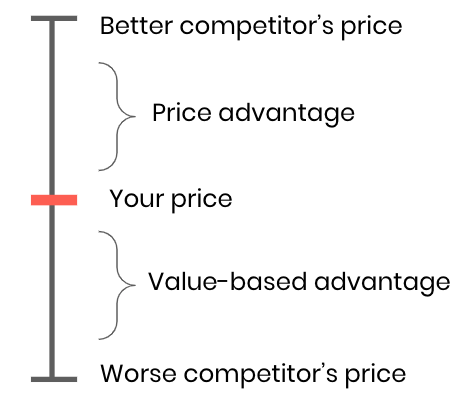
By starting with your competitors’ prices that are better and worse than your product’s, you’re able to create a price bracket within which to dial in your price. Again, remember that knowing your customers’ willingness to pay is impossible, and so the goal is to triangulate your best estimate. So your pricing bracket makes this job easier. You can now progressively tighten the window with additional information.
On the high side, you know that you can’t charge as much for your product as that of your competitor’s better product. So you need to charge less. But how much less? It depends on how much that extra functionality is worth, and to whom. Let’s say that the willingness to pay for that extra feature is $1,000/month for group A and $500/month for group B. Should you price your product $1,000/month cheaper than your competitor or the lesser amount? It depends. Is your company a small startup that is content to target only group B for now? If so, you should charge the higher price of your competitor’s price minus $500/month. But if you work for Microsoft, and anything less than 50% market share in this space is a failure and undermines the strength of the Microsoft Office Suite? Well then, you’re going to need to target the entire sellable addressable market (SAM), by keeping your price low at $1,000 less than your competitor’s stronger product.
On the low side, the same logic holds. How much more should charge than your competitor does for their weaker product? Basically, you should use the value-based pricing method to calculate how much incremental value your extra features generate for the customer. You should do the same work of segmenting the market and looking at how much of the market you are willing or need to target to determine how aggressive (low price) or conservative (high price) you should be in your pricing.
Realistically, when making these two value based calculations, there may be some overlap or space in the band that isn’t covered. In that case, the rest is more art than science. At that point you should come with what is simplest and what looks like a rational pricing system as a whole because you are likely pricing multiple tiers or a range of products and they need to make sense as a system or a whole.